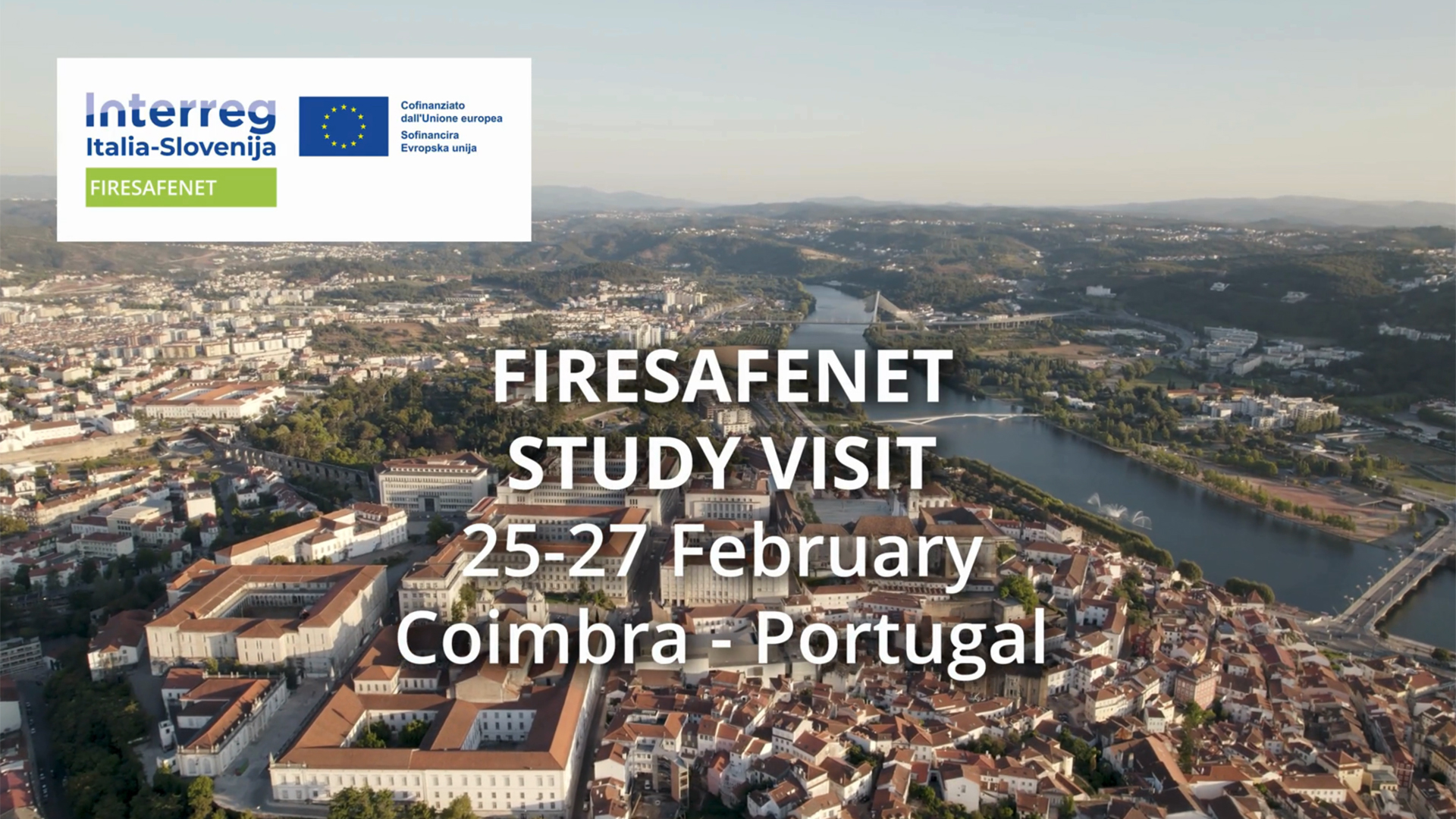
The international Study Visit promoted within the framework of the FIRESAFENET project, co-financed by the European Union under the Interreg VI-A Italy-Slovenia Program , which from February 25 to 27 brought together international experts engaged in forest fire risk management for three days, resulting in an intense moment of confrontation and exchange of expertise, has come to an end.
ISIG, as a project partner, organized the Study Visit in collaboration with the Center for Forest Fire Research (CEIF), a research unit of theAssociation for the Development of Industrial Aerodynamics (ADAI), based at the University of Coimbra.
The initiative provided an important opportunity for the exchange of best practices, innovative tools and operational strategies between professionals, institutions and the world of research, concretely strengthening cross-border cooperation between Italy and Slovenia. The event is part of the FIRESAFENET project, which aims to strengthen collaboration between the two countries in forest fire risk prevention, preparedness and response. Through coordination and discussion between operational actors, institutions and research organizations, FIRESAFENET promotes a shared and integrated approach to risk management, strengthening the capacity of territories to deal effectively with fire-related emergencies.
At the heart of research: the LEIF in Lousã
The first day opened at LEIF | Laboratório de Estudos sobre Incêndios Florestais, in the Lousã airport area, about 27 kilometers from Coimbra. The laboratory is run by the Centro de Estudos sobre Incêndios Florestais (CEIF – ADAI), active since 1985 in applied research on fire behavior and safety in forest fire scenarios.
CEIF director Xavier Viegas opened the proceedings with a lecture devoted to the evolution of fires in Portugal. Climate change and socioeconomic transformations, he explained, are profoundly changing the behavior of fire and its impact on territories.
Meteorologist Daniela Alves then illustrated the crucial role of weather factors, focusing on instruments such as the Canadian Forest Service Fire Weather Index System and the Haines Index, which are critical for assessing fuel moisture, fire spread and intensity.
Space was also given to the crucial topic of the urban-forest interface (WUI), analyzed by Miguel Almeida, who described typologies, risk factors and self-protection strategies to strengthen the resilience of exposed communities. The morning closed with Luís Mário Ribeiro’s talk on operator safety and the evolution of operational protocols in light of past tragedies.
In the afternoon, between lectures on fire behavior and controlled fires, laboratory demonstrations led by Tiago Rodrigues made the theory tangible: flames observed up close, dynamics analyzed in real time, close comparisons between the Portuguese and the Italian-Slovenian karst contexts.
By the end of the first day, participants had already acquired new scientific and operational keys, laying a solid foundation for future cooperation.
On the trail of Pedrógão Grande
The second day led the delegation to the sites of the Pedrógão Grande tragedy, where in 2017 a devastating fire claimed the lives of 66 civilians and rescue workers. An event that deeply marked the country’s recent history.
Led again by Miguel Almeida, participants visited Ferraria de São João, one of the affected villages. Here an innovative protection system has been developed: a 100-meter buffer zone with selected trees, active management of forest resources, and projects to enhance the local economy. An emergency shelter is also being built, intended to become a multipurpose space for the community during periods of normality.
The tour continued to the Pobrais memorial and Escalos Fundeiros, stops that provided an overview of fire development and lessons learned in emergency management, risk communication, and operational coordination. Nearby areas affected by prescribed fire, a practice central to Portugal’s preventive strategy today, were observed.
Moments of recollection and technical analysis were interwoven, reminding us how behind every protocol are scarred lives and communities.
The international seminar: comparing models
The Study Visit concluded on Friday, Feb. 27, with the international seminar “Wildfire management systems in Slovenia, Italy and Portugal,” hosted by the Universidade de Coimbra at the Faculty of Mechanical Engineering.
The meeting, organized in collaboration with ADAI’s CEIF, brought together representatives from agencies and bodies involved in fire risk management in the three countries. The focus of the discussion: emergency governance systems, operational procedures, field experiences and lessons learned.
The discussion gave concreteness to the value of European cooperation. Sharing knowledge, experience, and expertise-along with strengthening relationships based on trust and cooperation-is a decisive step toward increasingly integrated and effective forest fire risk management.
For FIRESAFENET, the Portuguese leg was not just a study visit, but a test case: learning from a historically fire-exposed context to strengthen the resilience of the Italian-Slovenian cross-border area. An example of how memory, science and cooperation can transform a tragedy into shared knowledge and concrete action.